The Best Marketing Metrics to Track (Without Getting Lost in Data)
Most businesses are buried in marketing data. Multiple dashboards, endless reports, and dozens of numbers competing for attention, yet none of it makes decisions easier. When you track everything, you lose sight of what drives growth.
The right metrics should simplify your work, not create noise. A small set of meaningful numbers can tell you where to invest, what to fix, and what to scale. When you focus on the numbers that directly impact performance, marketing stops feeling chaotic and starts feeling predictable.
This guide cuts through the clutter. You’ll learn which metrics deserve your attention, how to track them simply, and how to turn that data into smarter marketing campaigns.
Ready to stop guessing and start measuring? Let’s dive in.
What Are Marketing Metrics? (And Why Most People Track the Wrong Ones)
Marketing metrics are the measurable signals that track how your campaigns perform, like sales generated or visitors to your site. They go beyond surface activity and help you decide where to invest, what to change, and what to scale. Good metrics connect marketing efforts directly to business outcomes.
The problem is that many businesses end up tracking vanity metrics that look impressive but don’t translate into income. Your site might generate 50,000 page views, but if those visitors never become customers, the number creates false confidence instead of insight. You end up buried in reports that look busy but don’t guide decisions.
This happens because marketing platforms make it easy to measure activity and harder to measure outcomes. Dashboards fill up with impressions, engagement rates, and reach statistics. Without linking those numbers to sales or qualified leads, you’re collecting data that feels busy but doesn’t strengthen your digital marketing strategy.
The Three Foundation Metrics Every Business Needs

Most businesses drown in data because they track everything instead of the metrics that predict growth. You can ignore 90% of your analytics and still make better decisions by focusing on these three numbers that show whether your marketing works.
Customer Lifetime Value Shows Long-Term Revenue
If you want to understand what each customer is really worth, you need to track their total revenue over time. That’s what customer lifetime value (CLV) measures: the complete amount you’ll earn from one customer throughout their entire relationship with your business. It reveals whether you’re building on repeat customers or constantly chasing new one-time buyers.
The impact is easier to see with a simple comparison. A customer who spends $50 once gives you $50 in lifetime value, but a customer who returns monthly for a year at $50 each visit generates $600.
If your average customer lifetime value is $500, spending $100 to acquire them is sustainable. Spending $600 isn’t.
Customer Acquisition Cost Reveals What Growth Actually Costs
CAC is your total marketing and sales spend divided by new customers acquired. If you spent $10,000 on ads last month and brought in 50 customers, your CAC is $200. This number tells you whether growth is sustainable or if you’re burning budget faster than customers can pay it back.
Track this monthly to spot trends. Rising CAC means your campaigns are getting less efficient (or you’re targeting harder-to-convert audiences). Most businesses don’t notice CAC climbing until they’ve already wasted months on ineffective channels.
The CLV: CAC Ratio: Your Profitability Reality Check
The CLV: CAC ratio reveals whether your business model is profitable. It compares what each customer is worth to how much it costs to acquire them. A healthy benchmark is 3:1, meaning each customer should generate at least three times what you paid to acquire them. That margin covers operating costs and leaves room for profit.
If your ratio drops below 3:1, you’re bringing in customers but losing money on each one. Growing faster just means losing money faster.
These three metrics work together to show the complete picture: what customers are worth (CLV), what they cost (CAC), and whether the math works (ratio).
Digital Marketing Metrics That Actually Change Decisions
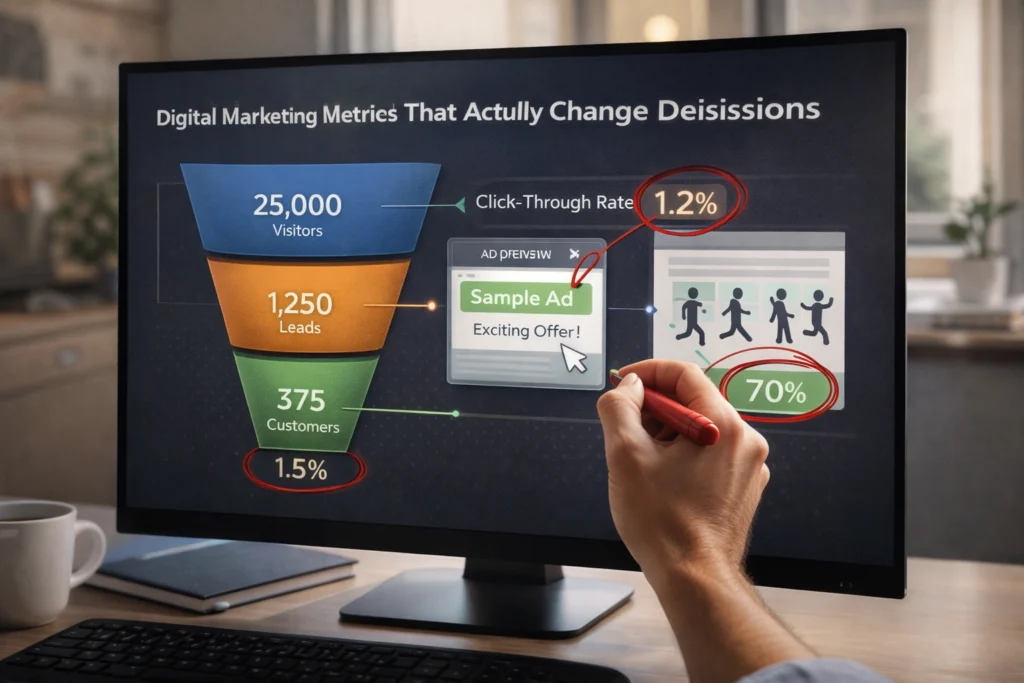
Some metrics just tell you what happened. Others point you toward specific fixes. Conversion rate, click-through rate, and bounce rate fall into the second category because they reveal exactly where your digital marketing campaigns are breaking and what to test next.
Conversion Rate: Find Where Visitors Drop Off
Conversion rate is the percentage of visitors who complete your desired action (purchase, signup, download). Track this at each step of your marketing funnel to see where people abandon the process. If 1,000 people hit your landing page but only 20 buy, that’s a 2% conversion rate.
What to do: Test each step where website conversions drop. Is it happening between the product page and the cart? Try simpler checkout flows or add trust signals. At the cart itself, experiment with pricing displays or shipping options. Small fixes here multiply across all traffic.
Click-Through Rate: Test Messaging Before Scaling
If 100 people see your ad and 2 click it, your click-through rate is 2%, which is low by most industry standards. It often means your headline or creative isn’t compelling, even if you’re targeting the right audience. High CTR (4% ) means your message resonates.
What to do: Run 3-5 headline or image variations in your email campaigns before scaling ad spend. A CTR jump from 2% to 4% means you’ve doubled your engagement rate without increasing budget.
Bounce Rate: Catch Mismatched Expectations
Bounce rate tracks visitors who land and immediately leave. A high bounce (70% ) usually means your page doesn’t match what the ad or search result promised. That disconnect costs you opportunities because your website traffic might be right, but the landing experience is wrong.
What to do: Match landing page headlines to ad copy. If your ad promises “free shipping,” make sure that’s the first thing visitors see. This alignment keeps visitors engaged and can reduce bounce rates.
Campaign Success: Measuring Your Ad Spend Without the Overwhelm

Want to see if your advertising budget is producing results? Return on ad spend (ROAS) makes that clear. Think of it as revenue per dollar spent. For example, if you spend $1,000 on Google Ads and generate $4,000 in sales, your ROAS is 4:1.
ROAS keeps the focus on outcomes, not vanity metrics like impressions or reach. Many campaigns aim for 3:1 or higher, though the ideal target depends on your margins and business goals.
Overall ROAS gives you the big picture, but channel-level tracking reveals where your budget performs best. Many businesses overspend on weaker channels while underfunding stronger ones. Adjusting ad spend based on real campaign performance improves marketing ROI and leads to steadier results over time.
How to Pick Which Metrics Are Right for Your Business
The metrics you pick depend on what you’re trying to achieve right now. For instance, a business focused on growth needs different numbers than one trying to increase profit margins.
Start by deciding your main business goals this quarter. Are you focused on acquiring new customers, increasing repeat purchases, or improving retention? Your answer determines which marketing metrics you should track.
Once you know your main objective, choose metrics that directly measure progress toward it. Focused on acquisition? Track qualified leads, cost per customer, and conversion rates. For retention, watch customer lifetime value and repeat purchase rates. Your key performance indicators should align with your marketing strategy, not just what’s convenient to measure.
Keep it simple from there. Limit yourself to three main marketing metrics per campaign. Tracking everything dilutes focus and makes it harder to spot what’s moving the needle. When you know which numbers drive your marketing objectives, you make faster decisions about where to invest and what to cut.
Setting Up Conversion Tracking (The Simple Way)
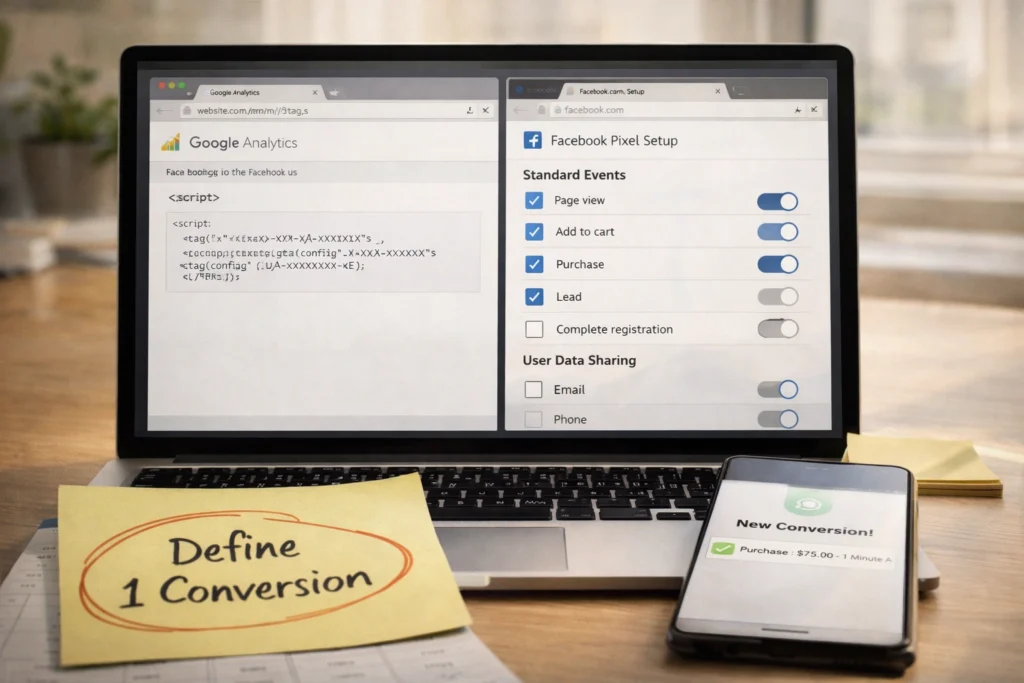
Conversion tracking sounds technical, but tools like Google Analytics and Facebook Ads do the heavy lifting once you tell them what counts as a conversion. Define it once (like a purchase, form submission, or phone call), and the platform tracks it automatically from there. Here’s how to set it up with the main platforms:
- Google Analytics 4: Install GA4 on your site and define your conversion events in the settings. The platform watches for those actions and records them without you touching anything else. You’re just telling it what’s important to your business.
- Facebook and Google Ads Pixels: Add the tracking code (called a pixel) to your website once. After that, the pixel monitors visitor behaviour and reports conversions back to the ad platform automatically. This lets you see which ads are driving actual results, not just clicks.
- Start With One Conversion Type: Get tracking working for your most important action first (usually form submissions or purchases). Advanced setups like multi-touch attribution can wait until you’ve nailed the basics and need that level of detail.
Pick the conversion that directly impacts revenue, set it up, and verify it’s working before adding more complexity.
Track Less, Learn More
You don’t need to track every number your tools can measure. Start with foundation metrics that show profitability: customer lifetime value, customer acquisition cost, and the ratio between them. Then add conversion rate, click-through rate, and bounce rate to see where campaigns falter.
Combining these with ROAS shows whether your ad spend is actually paying off. You get a clear view of campaign performance without getting lost in unnecessary data.
Ready to build a marketing strategy around metrics that drive real growth? Get in touch to start tracking what truly moves your business with digital marketing.